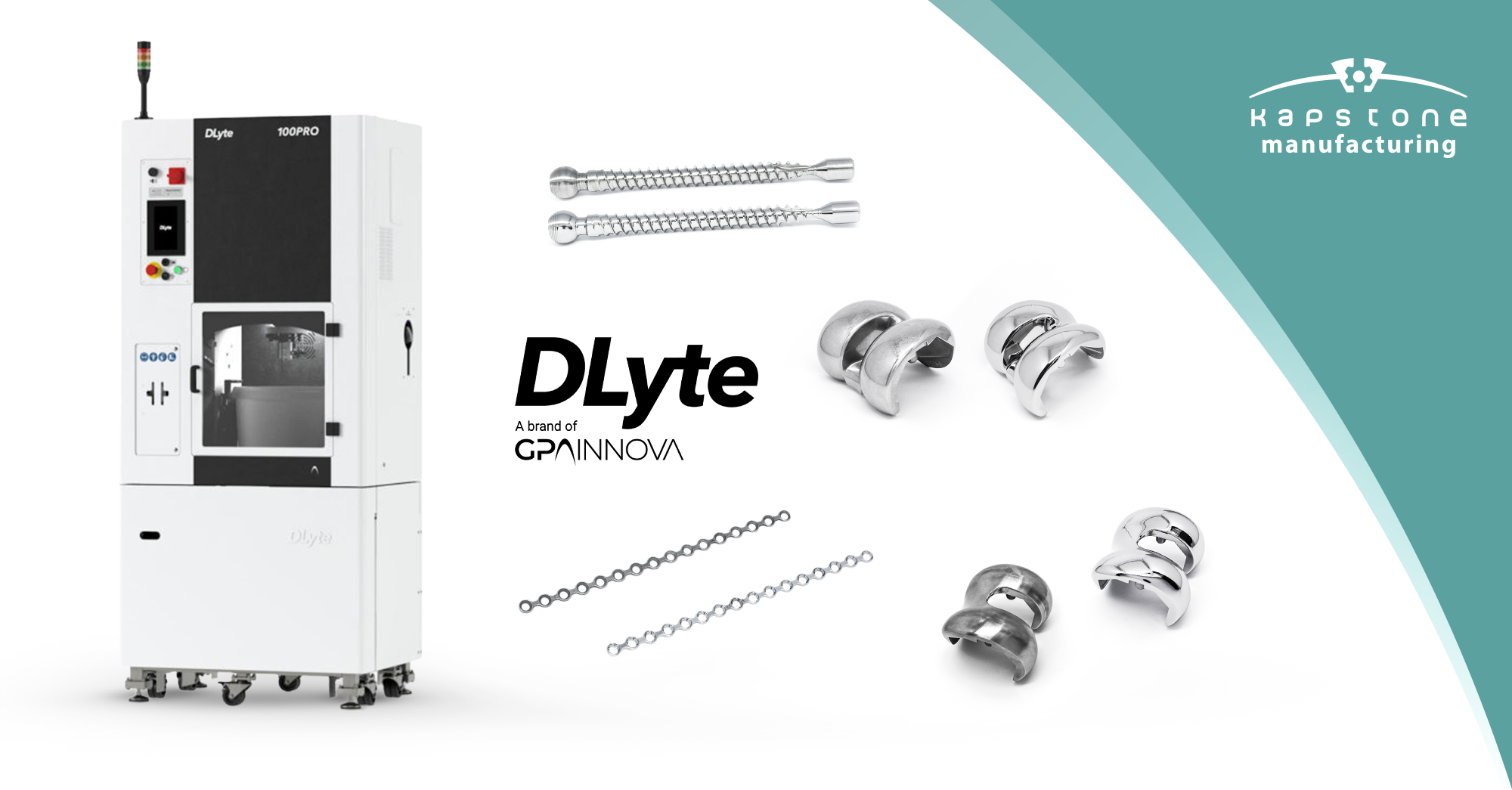
Kapstone Manufacturing does final finishing of metal parts by dry electropolishing on a DLyte 100Pro in Charlotte, NC. The process smooths stainless steel, cobalt chrome, titanium, nitinol and other alloys to below 0.1 µm Ra without abrasives, under the same ISO 13485-certified quality system as our metal additive manufacturing and other metal finishing processes.
What is dry electropolishing?
Dry electropolishing removes metal from a part’s surface electrochemically, using solid electrolyte media instead of a liquid acid bath. Material comes off the peaks of the surface first, so roughness drops while edges and features keep their shape. Nothing abrasive touches the part, which makes the process suited to complex and printed geometries that are slow or inconsistent to polish by hand.
What finishing services do we offer?
Finishing for parts we print. Parts printed on our SLM 280 move straight to finishing in the same facility, from raw print to finished surface.
Contract finishing for your parts. Send us machined, cast or printed parts. We finish them in production batches with a uniform, repeatable surface.
Feasibility runs. Considering dry electropolishing for your own facility? Send sample parts to Kapstone Manufacturing and we will will run them on a production DLyte 100Pro, and can provide before-and-after roughness and dimensional data, photos and process notes.
Who do we serve?
Medical device companies: implants such as knee femoral components, hip stems, bone plates and facial implants; surgical instruments, saw blades and ultrasonic bone-cutting tools; nitinol components.
Subsea, marine, oil and gas: stainless steel housings, connector bodies and flow components, where a smoother surface with fewer crevices supports corrosion resistance and cleaning.
Aerospace, defense and robotics: prototypes and low-criticality parts, fixtures and tooling, and polishing of injection mold components.
Equipment and materials
Specification
DLyte 100Pro
Process
Dry electropolishing (solid electrolyte, no liquid bath)
Part envelope
Ø 180 mm × 115 mm
Maximum load per cycle
8 kg (17.6 lb)
Surface finish, typ.
Below 0.1 µm Ra typically achievable, depending on alloy and starting surface. For metal additive 0.2 µm Ra typically achievable with dedicated pre-process step.
Alloys
Stainless steels (including 316L and 17-4PH), cobalt chrome, titanium, nitinol, copper, nickel and aluminum alloys
Quality Management System
ISO 13485:2016
From raw part to finished surface
Review: We confirm the material, geometry, starting finish, target roughness and critical dimensions.
Preparation: Support removal, machining of critical features, and media blasting or mechanical finishing where the part needs it.
Fixturing: Parts are mounted so every surface to be finished is exposed to the media.
Dry electropolishing: The cycle runs on the DLyte 100Pro with parameters set for the alloy and target finish.
Cleaning and passivation: as the part and alloy require.
Inspection: Surface roughness before and after, plus dimensional and visual inspection.
Marking and packaging: with the documentation defined for the program.
1 Osteosynthesis plate before and after dry electropolishing to mirror finish.
2 Femoral stem before and after dry electropolishing to mirror finish.
3 Prosthesis before and after dry electropolishing to mirror finish.
4 Femoral implant before and after dry electropolishing to mirror finish.
*Images courtesy of DLyte
When dry electropolishing makes sense
Dry electropolishing fits parts that need a low-roughness or mirror finish on complex geometry, where hand polishing is slow or varies from part to part, and where edges and fine features must be kept. It also gives a repeatable finish across production batches. Parts larger than the DLyte 100Pro build envelope, alloys outside the list above, or surfaces that need a texture rather than a polish may be better served by another method. We recommend the finishing method that fits the part.
Quality and documentation
Kapstone Manufacturing's quality system is certified to ISO 13485:2016. Production parts ship with documentation matched to the part and its application, which can include process qualification and validation records, material certifications, traceability records, inspection data, and finishing records. The quality agreement for each program defines the required package.
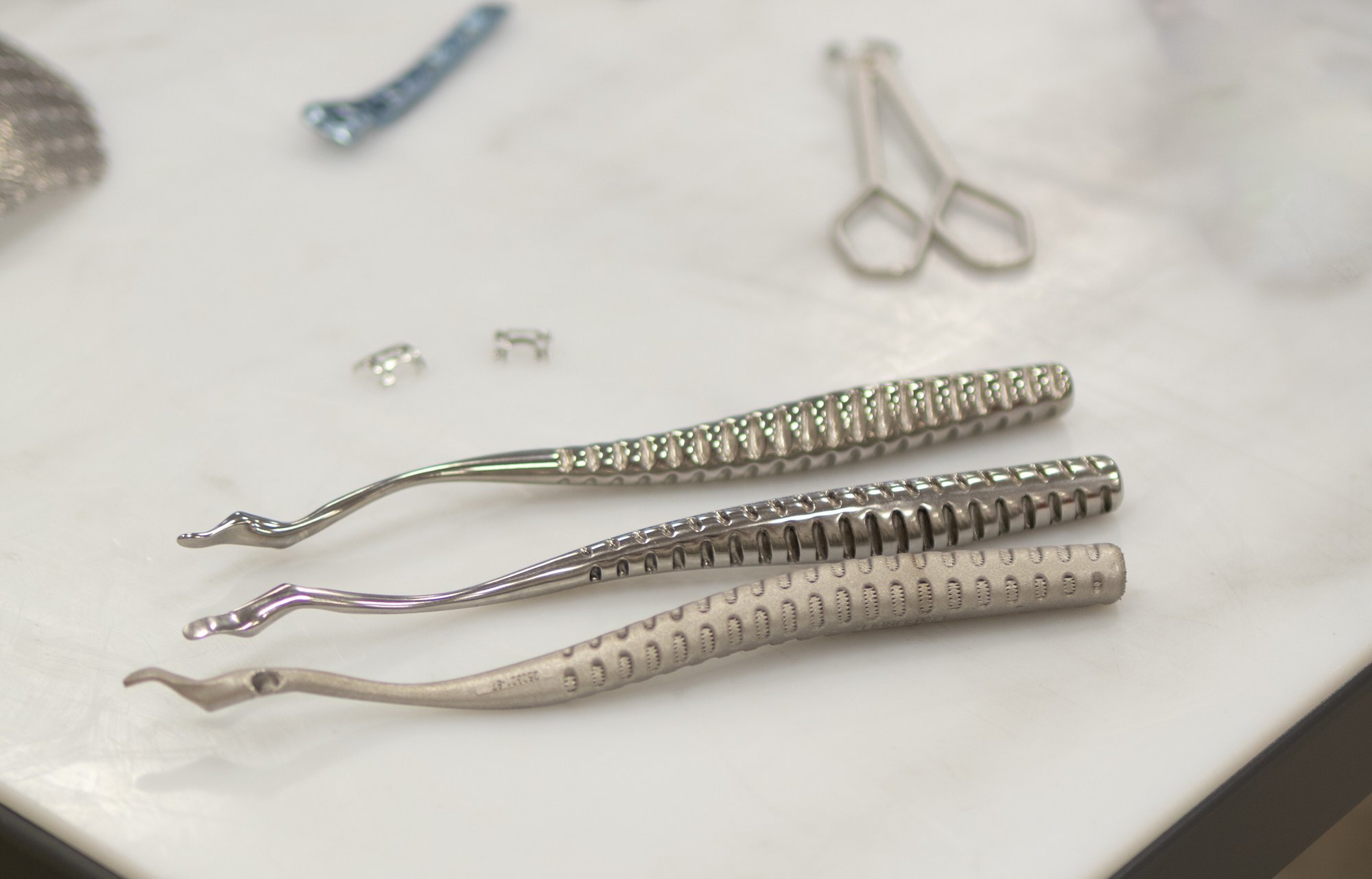
Example: DanaMed Pathfinder ACL Guide
For DanaMed, a Charlotte medical device company, Kapstone Manufacturing produces a reusable surgical guide in 316L stainless steel. Stainless steel parts like this guide can be printed on the SLM 280 and finished to a mirror surface with DLyte dry electropolishing, with printing, finishing and inspection under one ISO 13485 quality system.
FAQs
What is the difference between dry electropolishing and conventional electropolishing?
Conventional electropolishing immerses parts in a liquid acid bath. Dry electropolishing uses solid electrolyte media, so there is no liquid bath to manage, and it can reach a lower roughness on complex geometry while keeping edges and features.
Which metals can you finish?
Stainless steels, including 316L and 17-4PH, cobalt chrome, titanium, nitinol, and copper, nickel and aluminum alloys.
What surface finish can you achieve?
Below 0.1 µm Ra on suitable parts. The result depends on the alloy, the starting surface and how the part is prepared; we measure roughness before and after.
What size parts can you finish?
Parts that fit within Ø 180 × 115 mm, up to 8 kg (17.6 lb) per cycle.
Do you finish parts from other manufacturers?
Yes. We can finish machined, cast and printed parts from other manufacturers, and parts printed on our own SLM 280.
Does dry electropolishing change part dimensions?
It removes a small, controlled amount of material, mostly from surface peaks. We review critical dimensions before finishing and check them after.
Can we test dry electropolishing on our parts before investing in equipment?
Yes. We run your sample parts on a production DLyte 100Pro and can provide before-and-after roughness and dimensional data, photos and process notes.